Salt Road, Part Two: The Salt Flats
Four hundred miles of white, a broken fuel line and a notebook Nora has never seen before.
On the second day, the flats began.
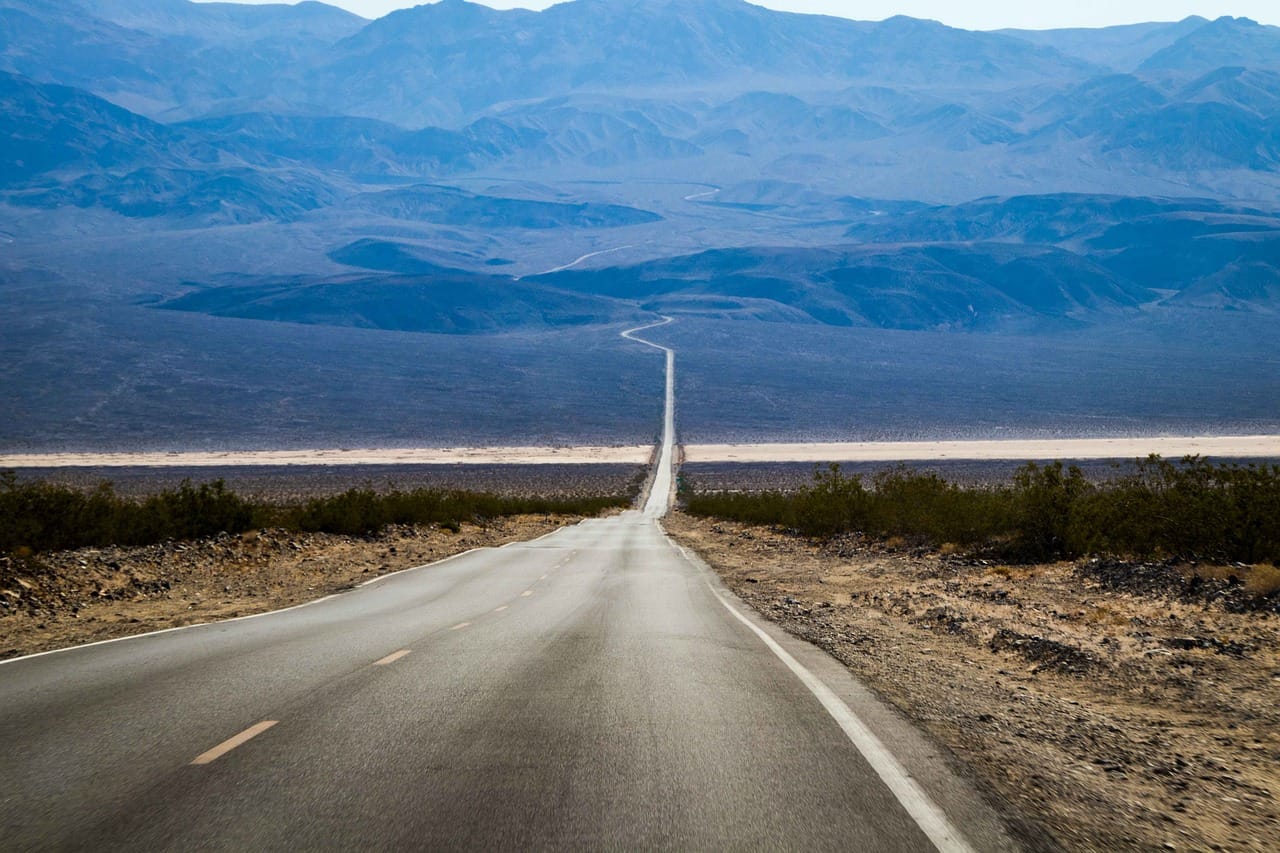
Nora had seen them in photographs, but nothing had prepared her for the size of them. The road ran along a low bank of gravel, a line drawn with a ruler, and on both sides the salt spread away to the edge of the world, white and cracked into hexagons like the skin of some enormous animal. There was no shade. There was no sound except the engine and, now and then, the tick of a stone against the bottom of the truck.
Teo slept for most of the morning with his head against the window and the tin box on his knees. He woke at noon, drank half a bottle of water in one go, and said: "My grandmother lived in Los Faros."
"Lived?"
"She died in the spring." He looked out at the salt. "I didn't go to the funeral. I was working. I thought there'd be time to go later. Then there wasn't, and then it seemed stupid to go when she wasn't there." He turned an orange over in his hands. "Now I'm going anyway. I don't know what I'm going to do when I get there."
"Me neither," said Nora.
By one o'clock, the heat in the cab was like a hand pressed flat against her face. They drove with the windows down and the hot wind roaring in, and did not try to talk. Twice they passed the bones of old salt company machinery at the side of the road: a conveyor belt rusted into the shape of a spine, a truck much older than theirs sunk to its axles in white. Once they passed a sign, bleached almost blank, that said LOS FAROS 280 and nothing else.
Teo told her about his grandmother in pieces, between long silences. She had been a teacher in the village when it still had a school. She had written to him every month since he left for the city at seventeen, long letters on thin blue paper, and he had answered perhaps one in four. She had never once complained. In the last letter, in February, she had asked him to come in the spring, when the almond trees on the cliff would be in flower. He had meant to. There had been a job, and then another job, and then the phone call.
At two in the afternoon, the truck stopped.
It did not break down, exactly. It slowed, and slowed, and sighed, and then it was standing still on the white road with the engine running and nothing happening when she pressed the pedal. Nora got out and stood in the heat with her hand on the bonnet, and felt, for the first time since March, like crying.
Teo got out too. He lifted the bonnet, looked inside for a long time, and then went round to the back of the truck and started taking things out of the toolbox that her father had built under the bed. Spanners. A jar of screws. A roll of wire. A notebook.
It was a school exercise book with a blue cover. On the front, in her father's square capitals, it said SALT ROAD. Nora had never seen it before.
Inside was a record of every journey he had made. Forty-one of them. The date, the miles, the weather. What broke and how he fixed it. And at the end of each entry, one line, always the same shape: Stopped at km 212. Stayed an hour.
She turned the pages. 1981. 1982. 1990. The year she was born, 1992, he had written: Stopped at km 212. Stayed an hour. Told her about the baby.
"Told who?" said Teo, reading over her shoulder.
"I don't know."
He checked the post at the side of the road. It was km 208. "Four more," he said. "If we can get there."
Teo fixed the truck in forty minutes. It was the fuel line; the notebook said it had gone in 1996 and 2003 as well, and her father had drawn a diagram of how he had fixed it, with arrows. Teo followed the diagram exactly. When the engine caught again, he whooped so loudly that the sound went out over the flats and did not come back.
At km 212, there was nothing. The road, the salt, the sky. And then, as they slowed, Nora saw it: a small cairn of stones at the side of the road, knee high, built carefully, the kind of thing you would only see if you knew it was there. On the top stone, faded almost to nothing, someone had painted a name.
INÉS.

She sat down next to it. Teo, without a word, went back to the truck and stayed there.
She did not know who Inés was. Her mother's name was Carmen. There had been no Inés in any story she had ever heard. She sat in the heat and looked at the name and felt the anger that she had carried for six years begin, very slowly, to change shape. Not into forgiveness. Into a question.
She stayed an hour. When the sun went down, the salt turned pink, and then blue, and then silver under a sky so full of stars that the dark between them seemed to be the rarer thing. Teo came and sat next to her with two oranges and gave her one.
"Forty-one years," he said. "He stopped here forty-one years."
"Yes."
"Whoever she was," said Teo, "he didn't forget her."